If you want to be informed when a new interview is online, follow us on Instagram and LinkedIn
For any question or potential interview requests, write to info@developments.media
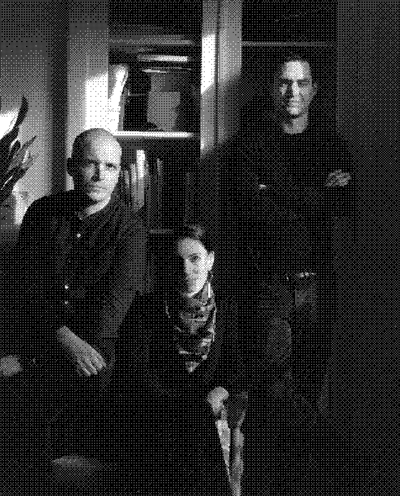
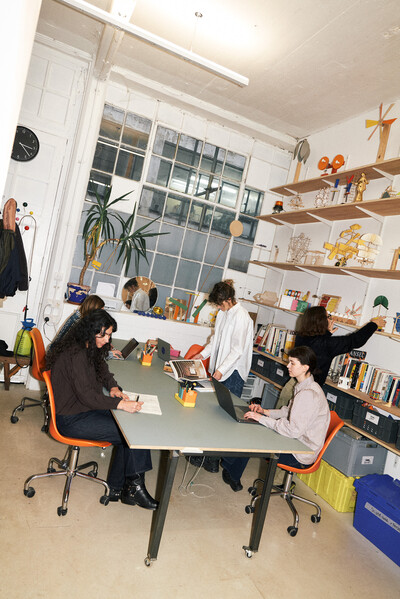
Developments was founded by Simon Descamps, Isabelle Moisy-Cobti and Antoine Soubrier (pictured above, from left to right) who are the managing partners of Bildung.
Developments website has been designed by Bureau Antoine Roux and developed by Tristan Bagot.
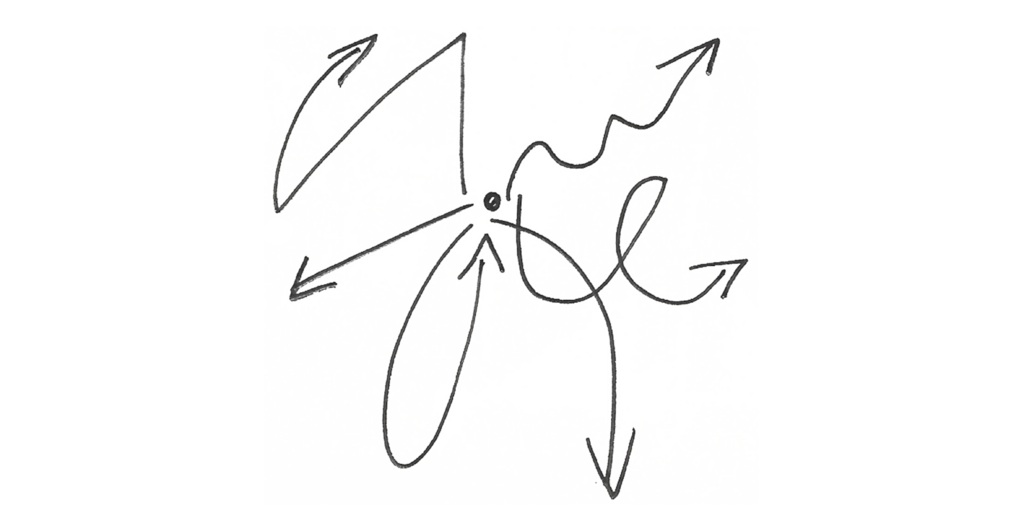
Could you please introduce yourselves?
I
We’re a multidisciplinary 3D creative studio based in London, specializing in 3D installations, film, and the exploration of materials, mechanisms, movement, and performative sculpture.
Our work focuses on physical rather than digital 3D, our creations exist in the real world, even when they’re made for digital content. We don’t see ourselves solely as set designers or installation artists, but rather as a 3D studio in a broader sense.
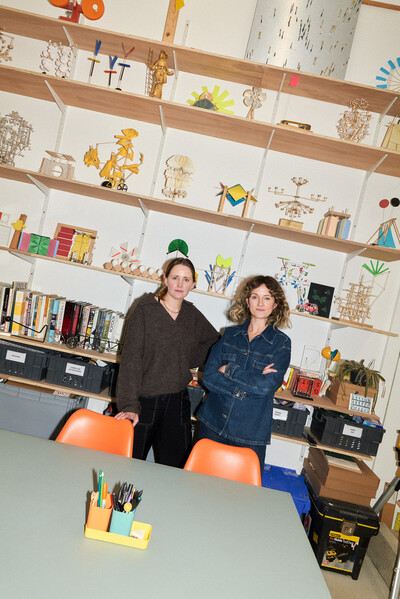
From left to right: Helen Chesner and Isabel Gibson
What’s your current state of mind today?
I
Helen is currently on maternity leave, so I’m managing quite a heavy workload at the moment. I also took maternity leave two years ago, and that’s really when I realized how valuable it is to work as a duo, it allows us to keep the studio running even when one of us is away. We still talk about upcoming opportunities and future projects.
What are you currently working on?
I
Most of our current projects are under NDA or still being pitched, but we’re exploring more public installations at the moment, which is really exciting. We’re also continuing to work with commercial clients and brands to create experiences and films. At the same time, we want to develop large-scale performative sculptures, especially within scenography and immersive installation work like we did for Coachella this year.
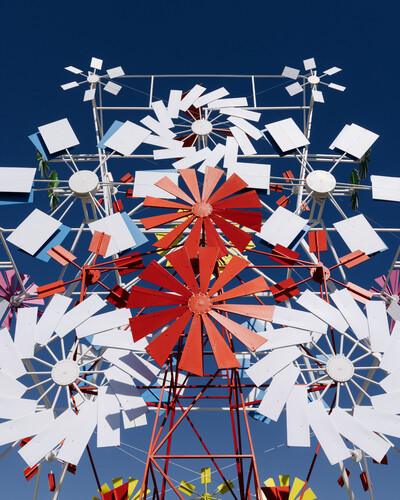
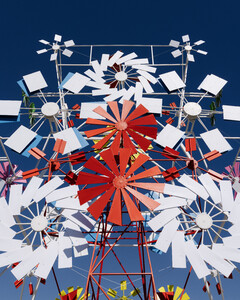
Coachella 2025
How did you meet?
I
We met at Chelsea College of Art in 2010, where we both studied Graphic Design and Communication. But it definitely wasn’t about graphic design but more about the communication of ideas through different channels. We started collaborating a few years after graduating, in 2015.
Helen brought her practical skills from set design she learned while working with Robert Storey. And I went to work with Hotel Creative, which contributed to my technical experience in retail design. It was great that we had those two pools of reference and two pools of knowledge to dip into. We have very similar ways of thinking altogether. Our practical and logical approaches, combined with a shared sense of humor, have really made working together feel natural.
What were your creative references when you were studying and when you started your practice?
I
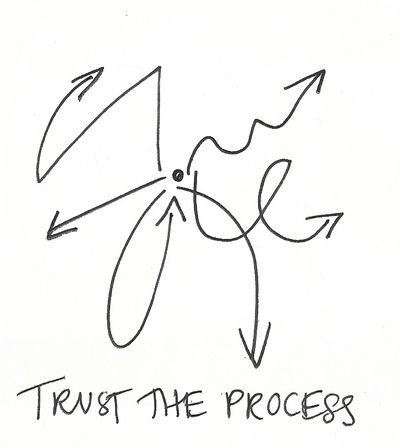
We’ve had quite a few creative references over the years. One of our early influences was the artist Daniel Eatock. We’re very drawn to the way his work is centered on process, where the process becomes the artwork, and his light, humorous take on everyday things. That really resonated with us, especially the idea that the method itself can shape the final outcome.
We were also inspired by Martin Creed, who has a democratic, accessible and playful approach to art, and finds new meaning in everyday objects.
A lot of this connects to our graphic design background. We learned to work in strategic and structured ways, setting boundaries and then exploring within them. Experimentation and process-driven thinking still guide us today, and we apply that philosophy across many different types of work.
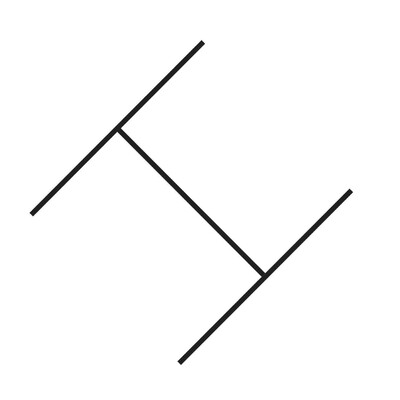
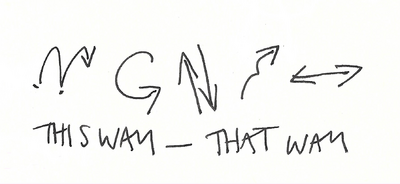
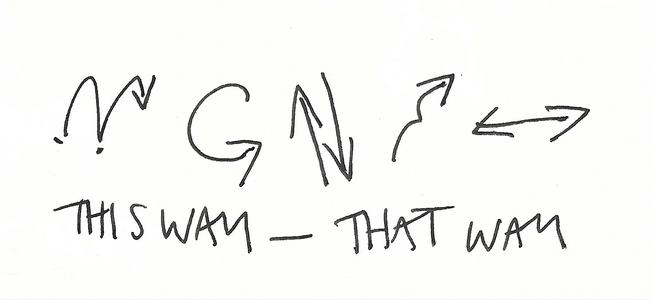
Isabel + Helen’s logo
What were your thoughts about the direction of the studio when you started it?
I
It all started very organically. It just happened naturally. We were simply exploring ideas and concepts we were interested in, without thinking too strategically about it at first. We had no money, so we made everything ourselves in the studio, which gave our early work a real DIY aesthetic. Over time, we built a body of work and brands started to notice this experimental way we were approaching materials and mechanisms. One of our first clients saw that playful, investigative spirit in our projects and was really drawn to it.
I think brands respond to the fact that we come with a design ethos rooted in experimentation. They bring us into their world, and we explore within it, which is exciting because it opens up new possibilities and new visual narratives. We’re not confined to one specific way of working. For us, it’s always been about exploration and applying that thinking across many different outputs.
You work on both brand commissions and art installations. How do you balance the two? Is it something you plan together, or does it happen more naturally over time?
I
The studio follows a very natural rhythm. When things are quiet, we invest that time back into our personal practice. When it gets busy, we take on as much work as we can, because commercial projects help support those exploratory periods. Over time this has created a cycle where intense project phases alternate with slower moments dedicated to experimentation and research.
A great example is our fan project. During a quiet stretch, we became interested in how sculptural movement could be generated through the body, which led to the fan backpacks and the fan hat. We developed an entire collection of suits and presented them at the V&A. That work then led to the commission for the V&A Christmas tree, and eventually to a project for Coachella. It evolved very naturally and took on a life of its own.
That’s why we value those quieter moments and trust our instincts. The ideas developed during those periods often grow in unexpected directions and lead to opportunities we could never have predicted.
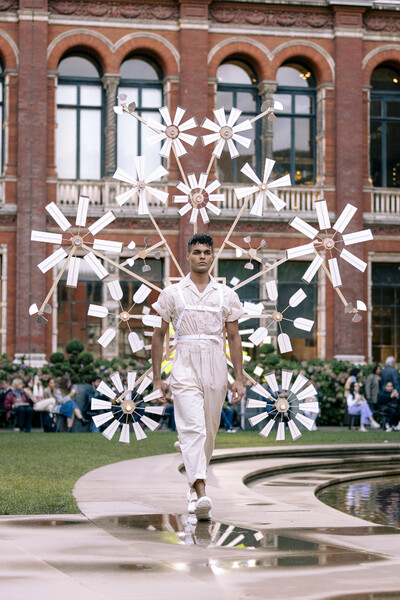
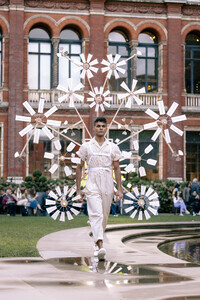
Power Suits at Victoria and Albert Museum
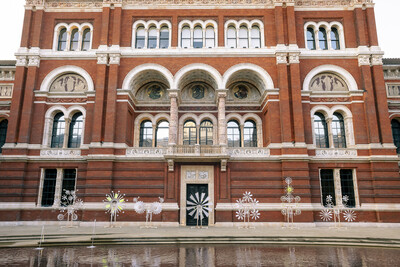
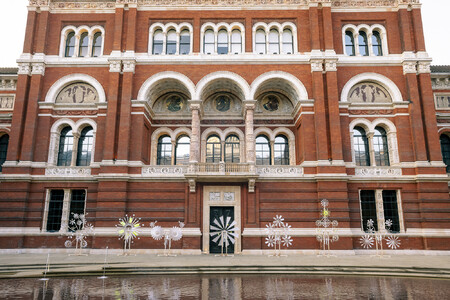
Power Suits at Victoria and Albert Museum
Do you have any strategy for developing your studio ?
I
When we choose projects, there is always some sense of direction. We think about where we want to go and make sure the work we take on connects, even loosely, to that path. At the same time, we avoid over-planning. The fan project showed us that trusting our instincts can lead to unexpected opportunities, so we like to keep space for experimentation.
We also believe that if you want a certain type of work, you often need to create it yourself first. That DIY mindset helped us build a portfolio that opened doors, and today clients are willing to trust us with ideas even when they have not seen anything similar before.
Looking ahead, we are very interested in developing more stage design and immersive installations. That world feels aligned with our interest in movement, scale and experience. At the same time, we are exploring the opposite scale through playful, functional objects. We have made a kinetic spinning candle powered by heat, a rotating kitchen egg holder, and we are now developing collapsible forms such as foldable chairs and a pulley lamp inspired by jumping jacks. Working across these scales, from immersive environments to everyday objects, keeps our practice dynamic and open.
How do you work at the studio? Do you have assistance? Do you have a studio manager?
I
Our team is very small. It is the two of us, a studio manager and a 3d designer who has been with us for two years. Because our projects vary so much, we work with a pool of freelancers including architects, makers, set assistants and film collaborators like a DOP. This flexible structure allows us to bring in the right skills for each project.
The studio manager joined two months ago and it has already made a huge difference. Before that, I was managing all the day-to-day operations, which meant I had almost no time for creative work. Having that support has taken a massive weight off my shoulders and allowed me to get back to the creative side of things, which is where I want to be. I am also really looking forward to Helen returning in January, so we can both focus more on direction and creative development.
In terms of roles, there is no strict division between us. We are incredibly similar in how we work. We generate ideas together and then divide projects as they progress, with one of us taking the lead later in the process. But the early stages are always collaborative. That shared brainstorming and bouncing ideas off each other is essential to how we work.
You’ve been working with an agent. What’s your relationship to your agent?
I
Our agent is incredibly helpful on the business side of things. They support us with contracts, client communication and the more administrative or strategic parts of the practice that are not our natural focus. It is also great to have an external perspective, because when you are deeply immersed in the work, it can be hard to step back. An agent can offer feedback, open doors, and connect us with a wider network of artists and collaborators, which has been really valuable.
We have been represented for about five years now. We reached a point just before COVID where we realized we needed external support, especially to navigate commercial projects and the direction of the studio. Working with an agent felt like the right step.
What was, retrospectively, a project that shifted things for the studio ?
I
The Craig Green collaboration really pushed us into a completely new realm. We went from experimenting in the studio with bin liners and prototypes one week to creating eight-meter-tall inflatable pistons for his show with Moncler in Milan the next. Seeing the collection presented around these huge moving structures was a real pinch-yourself moment.
That project opened a new direction for us, and we continued working with Craig and Moncler for several seasons afterwards. Craig and his team really value artistic individuality, and that mindset has had a big influence on us. It feels like more brands are embracing that approach now.
We also created window displays for Hermes early on in our practice, which was another incredible opportunity. They are a unique brand with a distinctly artist led approach to their communication and trusted our vision completely and gave us the freedom to create ambitious pieces.
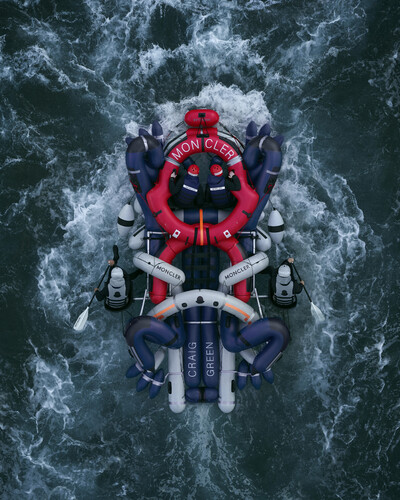
Moncler × Craig Green AW21
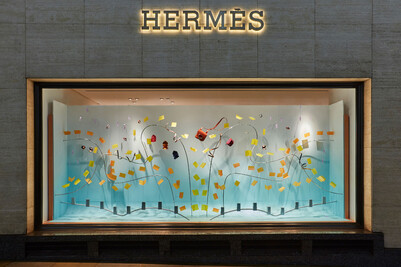
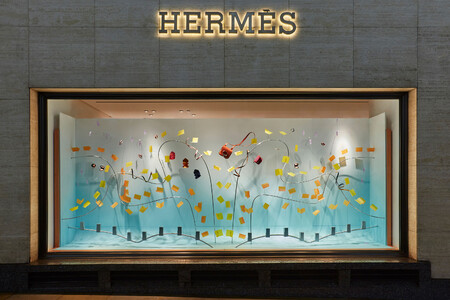
Hermès Windows SS22
How are you managing social media and your online presence?
I
Instagram has been a huge tool for us. Our process is central to our practice, and the platform lets us share how we think and make, not just the final result. It feels right to let the work speak for itself, so we have always avoided putting ourselves too much at the front. The name came out of necessity when we were preparing a project for the V&A and needed to decide quickly. We chose our first names and it stayed. We like its honesty and simplicity, and the contrast it creates with work that can sometimes feel industrial, technical or quite hands-on. It reflects who we are and how we work together.
Defining ourselves has always been tricky because the studio is constantly evolving. We do not sit neatly in one category as “artists” or “designers,” and our practice shifts depending on the projects we pursue each year. Our work moves, changes and grows, so trying to pin it down in a single bio never feels quite right. In a way, the lack of a fixed definition reflects who we are and how we work.
What’s your take on AI? Do you experiment with it in your practice, and do you see it as more of a tool or a potential threat?
I
AI is definitely worrying for the creative industries, but I also think it highlights the value of real craft. As digital content becomes easier to generate, the handmade, the tactile and the imperfect will feel even more meaningful. There is something powerful about knowing something truly exists, that it was built, touched and tested in the real world. That emotional connection cannot be replicated by AI.
A lot of our work, even in fashion or campaign contexts, relies on scale, physicality and ambition. For example, when we created large floating rafts for Moncler, the excitement came from the fact they actually existed. Today that could be simulated digitally, but seeing it in real life captures imagination in a completely different way. I think brands and audiences will continue to value that.
In that sense, AI might actually push things in the opposite direction and make live experiences, installations and performance even more important. We are already seeing that in music and culture, where shows and physical experiences are becoming bigger and more immersive. It feels like a space full of opportunity for us.
At the same time, we are not naïve about technology. AI will accelerate parts of the creative process, especially visualisation and reference-building, and that could free up time for making. We haven’t used it much yet, because our studio has always been quite analogue, but we know it is here to stay. It is important to adapt and explore how it can support the work, rather than ignore it.
Are there any books that have influenced your development, either personally or professionally, that you would recommend?
I
Most of the books we return to are very practical ones about making. We have a few technical references in the studio, including a favorite book on collapsible structures and folding techniques that we keep going back to. That probably reflects the way we work: we like books that teach us something we can try or build.
In terms of creative inspiration, we often look to Charles and Ray Eames. The way they moved across disciplines and applied a consistent design philosophy to so many different forms has always resonated with us. Or dutch artist and inventor Theo Jansen who created giant wind powered walking kinetic sculptures out of plastic pipes and sails. There’s something so magical about the use of such basic materials to create something so engineered and complicated.
Both studying together, we had a 2nd year tutor called Kieron Dennis who was a huge influence on us. He encouraged a real focus on the process, and the journey that might take you on rather than necessarily the final outcome. This gave room for the ‘designer’ and ‘artist’ to co exists within projects and encouraged that multi disciplinary approach. The outcome was also rarely fixed, which let us create freely to answer the brief in whatever way was most impactful, we worked on outcomes that spanned joke books, documentaries based on bread making in Peckham, and a ‘pointless’ mechanical sculpture which clicked a pen. This exploration way of working has led us into the way we work today.
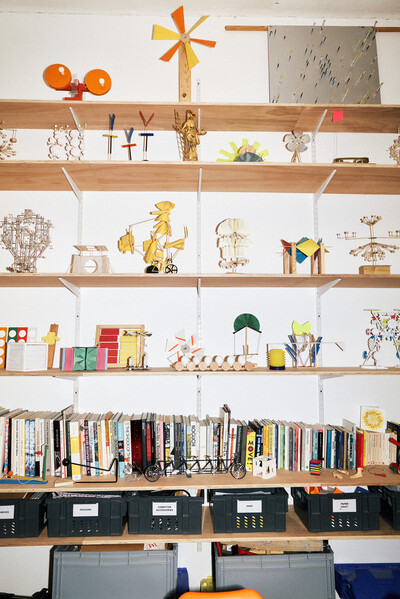
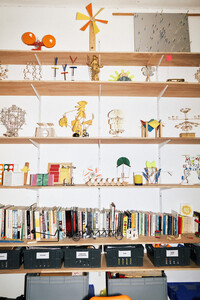
If you could leave and work at a different time, different place and job what would you like?
I
It would be great to own a toy shop from about a hundred years ago, when everything was handmade, kinetic and full of imagination. We are really inspired by children’s toys, there is so much joy, curiosity and mechanical play in them, which aligns with how we think about movement and design. I have twins who are two, so toys are a big part of my daily life at the moment, and they spark so many ideas.
What is a simple piece of advice you’ve received that you would pass on to young creatives starting their journey?
I
Focus on what genuinely interests you and try not to get distracted by what everyone else is doing. Trust your instincts and your direction. You never know where it might lead, but staying true to what you believe in will always take you somewhere meaningful.