If you want to be informed when a new interview is online, follow us on Instagram and LinkedIn
For any question or potential interview requests, write to info@developments.media
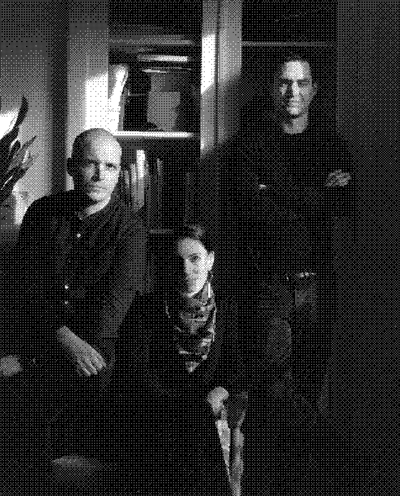
Developments was founded by Simon Descamps, Isabelle Moisy-Cobti and Antoine Soubrier (pictured above, from left to right) who are the managing partners of Bildung.
Developments website has been designed by Bureau Antoine Roux and developed by Tristan Bagot.
Hi Sarah, can you please introduce yourself?
My name is Sarah Bassett. I am a Creative Director, originally from Australia, but I have been living in Paris for 3 years now. Before that, I lived in New York for 17 years, so at this point I have actually spent more of my life outside Australia than in it.
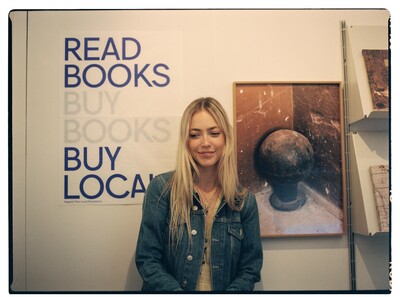
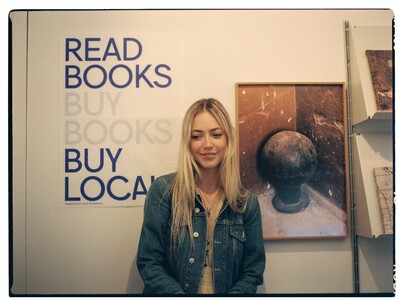
Sarah Bassett
How would you describe your current activities?
I am a Creative Director, but how that plays out day to day is incredibly varied. I have a very unconventional background. I started in magazines, at places like Visionaire and Vice back when it was still a print publication. Then I accidentally shifted into advertising because my boss at the time pointed out that I could do similar work and actually get paid for it.
That move put me on a nonlinear path. Coming from magazines, you have almost no money but complete creative freedom. In agencies, you often have all the resources in the world but far less creative space. My first real agency job was in a place that was famously chaotic in New York. It taught me a lot about how disconnected leadership can be, from the people actually doing the work. I remember thinking that if I ever led a team, I never wanted to create that environment.
So I spent about 10 years intentionally moving through completely different roles. I worked for stylists, magazines, brands, agencies, production companies, digital studios. I wanted to understand each layer well enough to communicate clearly when I was the one giving direction. I am dyslexic and I do a lot at once, so organization and clarity matter to me. I genuinely believe this job does not have to be chaotic if you respect the people involved.
Because of all that, my activities today are broad by design. Sometimes I come in as a full Creative Director, from strategy and positioning to shoot concept, production, post, and delivery. Sometimes I only do editorial layout or graphic design. Sometimes I do stage design for musicians. Sometimes it is pure strategy, sometimes digital or website-focused.
So the short version is that I am a Creative Director, but the way that expresses itself shifts completely depending on the project. I like that ambiguity. Especially in Paris, I see a lot of people doing one very defined thing. That is valid, but I think being ‘a creative’ in 2025 requires a much wider approach.
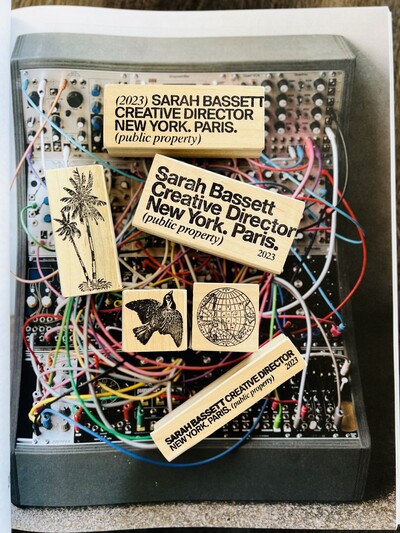
Sarah Bassett’s stationery
What is your current state of mind?
I had a pretty complicated 2025. It was probably one of the hardest professional moments of my career, and I was not in a great headspace. But I think sometimes you have to hit rock bottom to rebuild. Because of that, I now feel surprisingly calm and at peace.
That situation, as toxic as it was, forced me to realign with what actually matters to me, both professionally and personally. I realized I am more emotional than I like to admit, and that when you are in an environment or relationship that goes against your moral compass, it affects you deeply.
Coming back to a way of working that feels right, with people who feel right, has created a sense of calm and contentment that I am letting myself enjoy.
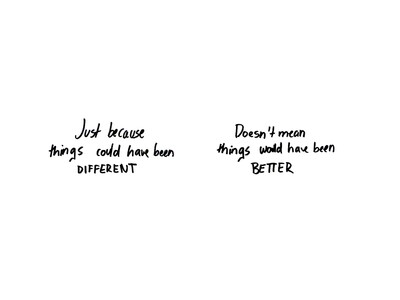
Sketch by Sarah Bassett
What first led you to design and visual culture?
I grew up in a small beach town in Australia. It sounds idyllic, but culturally it never felt like my place. I always had the sense of being slightly out of step with my environment. I loved art, fashion, cinema, magazines, I dressed the same way I do now, and listened to the same music; I have always been the same. None of it made sense in that context.
So fashion and visual culture became a kind of escape. I remember watching FTV obsessively. I had learned Italian at school, so hearing those fashion show commentaries felt like a strange lifeline to a world I instinctively understood, even if I had never seen it. From a very young age I knew I would leave, and that I would work in some creative field, somewhere far away.
Magazines were a huge part of that. They felt simultaneously, both familiar and completely foreign, and they gave me a sense of belonging that I never found in my own environment. Like most Australians, I took a gap year, and then without ever having been to New York, I simply decided, that was where I was going to live. In my mind it was the place where all the people who did not fit in elsewhere, somehow fit together.
Originally I studied film. I thought I might want to be an actor, probably because it felt like another form of escape, another way of stepping out of myself. But my first internship was at a casting agency, during the era of Hannah Montana and all those Disney shows, and it was an immediate wake-up call. I saw kids preparing for weeks for a role that was already cast. It made me realize how little control you have in that world. I quit on the spot. I knew I could not build a life on something that depended so heavily on luck, or being invited to the right party.
I went back to Australia, had a small existential crisis, read a lot of philosophy books, and then literally Googled what job combines photography, graphic design, fashion; the answer was art direction. I had never heard of it, but it made sense. You become the connector between all disciplines, the person who shapes the vision without necessarily being the technician.
That is how I ended up shifting degrees, returning to New York, and teaching myself everything I know. I am the kind of person who only learns by doing. And looking back now, it tracks: design and visual culture were never things I chose. They were the only things that made sense to me, the only world where I felt aligned. Even today, people ask why I do this work, and honestly I cannot imagine doing anything else. It feels too intertwined with who I am.
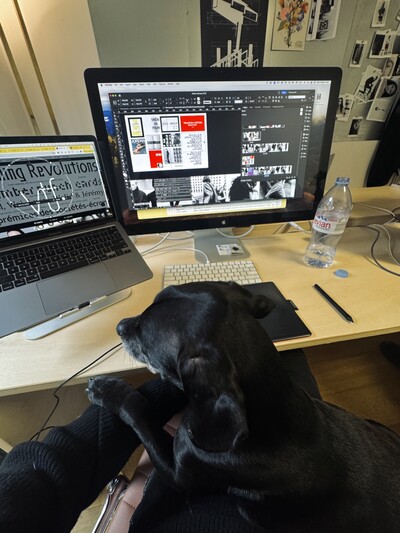
Sarah Bassett’s studio
You described intentionally trying different jobs to better understand the full creative ecosystem after that first agency experience. Can you expand on how you navigated that and what your thinking was?
I get bored very quickly, which I think explains a lot about how I approached those years. Once something becomes easy, I stop feeling stimulated. So after that first chaotic agency experience in New York, I realized I never wanted to be the kind of Creative Director who had no idea what the people below me were actually doing. I wanted to understand the whole ecosystem.
So I gave myself a mandate for the next 10 years: take jobs that challenge me, even if I have no idea what I am doing. Not to bluff my way through, but to grow by being slightly uncomfortable. That is how I learn.
Right after that agency, I went in-house at a brand. It was not a cool brand, but they took a risk on me. I came from editorial, which teaches you how to make something great with $5, plus I also had the structure of an agency background. At the time brands were just beginning to realize they needed in-house creative studios. So I built one from scratch. When I arrived there was 1 designer. When I left there were about 15 people and an in-house photo studio producing several shoots a month. Working in-house teaches you nuances you never see from the outside: product pressures, inventory issues, what actually drives decision-making from a commercial & product perspective. I liked that it made creativity measurable & took a level of subjectivity out of the equation.
Then I realised the digital world was exploding and I knew nothing about it. So I cold-emailed a digital agency in New York, gave them honest feedback on their portfolio, and they surprisingly asked if I wanted to help fix it. I made a deal: I would build their content studio, but in exchange they had to teach me how to design websites and work with developers. So at the same time I was leading a department that was making more money than the entire agency and simultaneously being a design intern, learning web grids. That experience is still one of the most valuable I have had.
After that I went to Milk Studios, set up another MVP creative studio, and helped launch Milk Makeup with Sephora. I had never worked in beauty, never built a brand from scratch, so again it was a new learning curve. Then I freelanced, briefly worked at Google in a VC to understand startup culture, and kept following this logic of filling in the gaps of what I did not know.
Eventually I was recruited by Ferdinando Verderi to work on Adidas Originals during its early years. My mixed background made sense for that world: editorial, digital, fashion, street culture. I worked on it for almost 6 years, eventually taking over when he went to Italian Vogue. Projects at that scale teach you things no agency can teach you: how budgets unlock, which department controls what…how those huge brands actually function.
Throughout all of this I was always freelancing on the side because I needed different types of stimulation. But eventually it became too much to juggle and I realized I had hit my ceiling at Adidas. So I left, started my studio in 2022, and moved to France in 2023.
So yes, exploring all those roles was intentional. It was the only way for me to understand the full creative ecosystem, speak everyone’s language, and eventually become the kind of creative director I wanted to be.
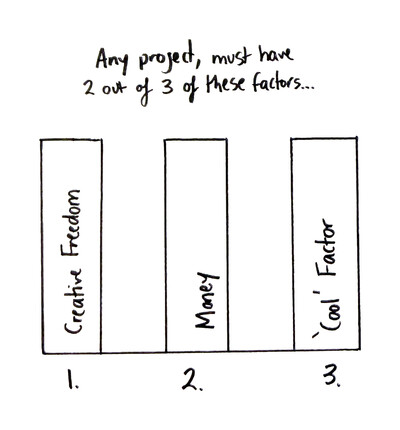
Sketch by Sarah Bassett
Who were your first creative references such as artists, designers, images or cultural influences?
Honestly, kids today are incredibly lucky in terms of access. The internet has made the entire world visible, but when I was growing up it was very different. Your exposure to culture outside your country/bubble was extremely limited.
One of my first real reference points was an Australian magazine called Russh. At the time it was the only interesting independent fashion magazine in the country. It had a writer, Lesley Arfin, who also wrote for Vice in New York. She felt like a modern Fran Lebowitz to me. That magazine was huge for my development. I still have every single issue ever printed. My dad still buys them for me in Australia and sends them over.
Looking back, it was probably the first thing that showed me there was a different way of thinking and seeing. I grew up in a beach town, very California or San Diego in spirit. Everyone wore Billabong and Rip Curl. The idea of even looking at photos of clothes that were not board shorts was already mind blowing to me.
And actually, I shot the cover of Russh last year. Trying to explain what that means to people in Paris in 2025 is impossible because here everyone is focused on the five or six “approved” magazines. But for me it was a real full circle moment.
I also remember discovering David LaChapelle’s work and being shocked that images could look like that. It is not my vibe anymore, but at the time it showed me that photography could feel dreamlike and surreal. When you grow up without museums or cultural spaces around you, even one book can completely shift your perspective and allow you to dream bigger than the world around you.
Even clothing was impossible to find where I lived. I literally worked in a surf shop selling wetsuits to Japanese tourists and refused to wear the store uniform. I used to go on eBay and buy clothes from Japan because it was the only place where I could find things I actually liked.
And this is funny, but even something like ASOS became a reference. When it launched, it stood for “As Seen On Screen.” They copied outfits worn by celebrities during that whole early 2000s Mary-Kate-and-Ashley, The O.C. era. It sounds silly, but for me it was a way of accessing another visual world.
So in a way, my earliest references were these odd, scattered touch-points I hunted down because there was nothing around me. Magazines, early internet culture, Japanese sellers on eBay, even cheap celebrity look-alike clothes. It was all I had, and it shaped me.
How do you maintain your creativity?
This is really important to me, especially because when I started out, none of the tools people rely on today even existed. There was no Pinterest. If you needed references, you physically sat in a library and went through every single issue of Italian Vogue from the 90s, looking for 6 images of a girl in a floral shirt. It was slow and painful, but it gave you context, depth, and an understanding of where images came from and why they mattered.
I think that is something a lot of people miss today. You see people posting so-called vintage references and they have no idea what the photo actually represented at the time, where it sits in a photographer’s evolution, or the cultural context around what that style meant at the time. For me, being able to look at a David Sims image from the 90s and immediately understand where it belongs in his trajectory, is a point of pride. That kind of visual literacy only comes from spending time with real sources.
So I still spend an insane amount of time in libraries. I have library cards everywhere, Paris, New York, even a strange research library in an industrial zone outside Milan that sends me 300 new images a month. When I was living in New York, I would spend entire days in a magazine archive. It is still one of my favorite things to do because it creates room for discovery and accidents. When you flip through a magazine, you do not know what you are about to find. Pinterest, on the other hand, gives you an algorithm, not a surprise.
And then there is the bigger, more personal part: to stay creative, you need to have a life. I learned that the hard way in my first agency job, where everyone was working until two in the morning and people were literally getting divorced. To be a good creative, you need to be a good person, and to be a good person you need time to think, to rest, to travel, to go to exhibitions, to simply exist outside work.
The reality today is that timelines have become almost impossible. You used to have 2 days, to shoot 8 images, with a real budget. Now you have 1 day, to shoot 20 images, plus an editorial, plus TikToks, plus reels, and the budget is divided by 10. So I protect my time. I maintain a very strict work–life balance because I need that space in order to actually think and stay inspired.
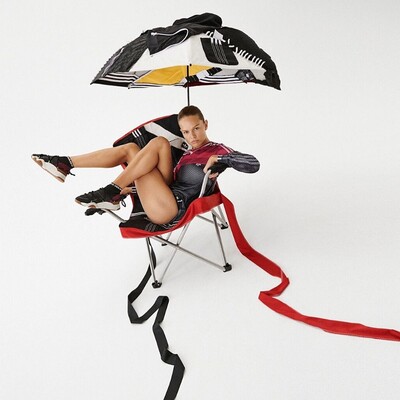
Adidas Originals × Alexander Wang — Brianna Capozzi & Hayley Wollens
How do you manage your time?
I have become almost machine-like in how I organise my time, which sounds a bit intense, but it is the only way I can handle how much I do. I work across many different types of projects, I am extremely hands-on, and I do a lot myself. So I have learned to compartmentalize my days in a very precise way.
When you work independently, it is easy to feel like you are always working and never working at the same time. You are never really off, but you also need to give yourself the space to be on. My best ideas rarely come when I am forcing myself to think in front of a screen for 10 hours. They usually come when I am travelling, in an unexpected gallery, or when I am simply living my life. So I prioritize giving myself time to rest and to be inspired. That is a big part of how I sustain my creativity.
For executional client work, I can drop in and out during the day. A lot of my time is also spent meeting photographers, directors, and other collaborators, which breaks the rhythm of the day, but is essential.
When I am doing work that requires deep creative thinking, I need long uninterrupted hours. I usually block an entire day for that because it often takes six or seven hours before I reach the moment where something clicks. And once it clicks, I can work for three hours straight with absolute clarity.
I also no longer function on a traditional 9-5 rhythm. I work when my brain works. For example, today I woke up at 6 and worked until 8. Then I prepared for this interview, went for a coffee, now I’m here, then I’ll work again, then have a meeting, then work again, then go to dinner, and probably work until midnight. The idea that you can be perfectly productive for 8 straight hours, at fixed times, feels unrealistic to me.
I am also someone who hates making people wait. If I know someone needs my answer to move forward, I feel the pressure of that, so my workday can get quite fragmented with emails. That is why my real thinking time tends to be either very early in the morning, very late at night, or on weekends, when no one is expecting something from me.
Do you have strategic references or mentors who have influenced your development?
My relationship to strategy, is both a blessing and a curse. I am naturally very strategic, and that has shaped the way I work with clients. One of the most important influences for me was Ferdinando Verderi. He is almost not visual at all, he cares about the idea above everything, and that completely reframed the way I think. I always tell my team that if I cannot step into an elevator and explain the entire concept in two simple sentences without a deck or an image, then it is not a strong idea. It needs to be that clear.
For client work, strategy becomes a negotiation tool. If we agree on ‘the why’ at the beginning, ‘the what’ becomes less subjective. It avoids conversations halfway through production, where someone suddenly asks ‘for the Eiffel Tower’ in a ‘Paris campaign’ when we already defined that their idea of ‘Paris’ is something else. Strategy protects the work.
As for my own development as a studio, I actually wish I had more guidance. Most of what I have done, has been intuitive. When I decided to leave New York, for example, it was not part of a structured plan. I just felt I could not do the work I wanted to do there anymore. No magazines, no clients I connected with, no taste that matched mine. Paris made sense. Only afterwards did people tell me it was a good strategic move.
I know I operate in a very intuitive way, but that instinct is always supported by an analytical mindset. I think that is why my brain feels split in two every day. On one side, I am the curious, creative part who follows what feels right. On the other, I am very business minded, organized, precise, almost to a fault. The dyslexia actually pushed me to be extremely structured, otherwise nothing would function.
What’s your plan for the next few years?
Everyone asks me that. I probably should have more of a plan, but I genuinely believe that things happen when they are supposed to.
This year alone my life at the beginning and my life now feel like two completely different realities. If I had stressed about the future back in January 2025, it would have been a total waste of energy.
Right now I am focused on clarifying the identity of my studio. People still think it is just me, which is partly true, but the scale of the clients I am working with means I need to communicate more clearly that it is a collective. At the same time, most people hire me precisely because it is me, because I am hands on and hopefully pleasant to work with. So whatever I build, it is important that it keeps that sense of humanity. I never want to grow to a size where I lose the personal relationship with my clients.
I am also realizing the limits of doing everything myself. You cannot run the business, meet every client, do the creative and be on set. There are not enough hours in the day. So I am working on a more formal studio structure, but in a way that still reflects my voice rather than another generic multidisciplinary creative agency between New York and Paris. I have my own version of that which I cannot talk about yet, but it feels right.
Beyond that, I want to develop two editorial book projects that keep getting pushed back when client work takes over. I worry about being pigeonholed as ‘a brand person,’ especially in Paris where magazines can be very protective and hard for external art directors to penetrate. I need an outlet where I can actually express what I want to say without the limitations of a client. Something that brings together my love of graphic design, editorial design, photography and a more intellectual writing component. Something that shows what I could do if I had full freedom.
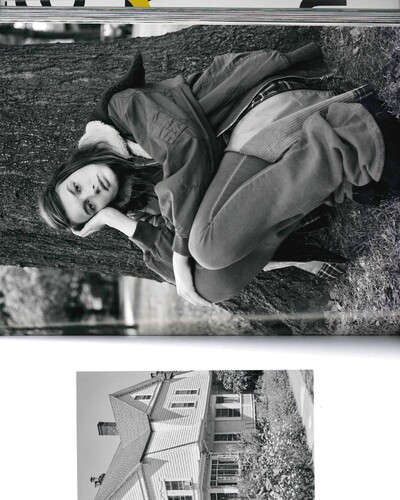
Muse Magazine — Ben Grieme × Zara Zachrisson
For young people reading this interview, what advice would you give them if they are trying to decide between joining a brand, joining an agency or working independently?
I can only speak from my own experience. I think you learn by doing, and right now we live in an attention deficit era where everyone is impatient and wants to ‘be famous’ and have followers and call themselves a Creative Director after one project. There is nothing more powerful than being humble, being curious, being prepared to be wrong and actually learning your craft. I never call myself a Creative Director when people ask what I do, because the term has become so disposable. Everyone is a “Creative Director” on Instagram now. But have you been hired and paid by a real company to do that job and deliver on that level? Usually not.
My advice would be: if you feel a pull toward something, go try it. Maybe you will hate it and that is already useful information. I also think if you really want to be a good creative today, you need to understand the entire ecosystem. I know Art Directors at brands, who have no idea how production works, or what things cost, or how budgets operate and that to me, is irresponsible. Our job is to take a brief and find the smartest creative solution within real constraints. You cannot do that if you do not understand the ingredients you are cooking with.
If you are curious about something, go investigate it. I was obsessed with lighting, so a few years ago I emailed a bunch of cinematographers and asked if I could shadow them. I wanted to understand how they work so that on set I can explain what I am asking for in real terms instead of saying vague things like “make it pop.” I am allergic to this kind of empty feedback that gets thrown around, because people do not actually know what they mean. If you do not know, ask. And if you want to know, go learn.
So my advice is: work for people, mess up, learn, be at the bottom of the ladder for a while. It gives you humility, and humility is essential. I work with young people now who are stressed that a client did not tag them on Instagram. I am like, the client does not tag me either, and I run the project. It cannot be the priority.
You do not know everything and that is ok. Be patient.
I heard a great quote this week: to break the rules you first need to know them.
That sums it up perfectly.
How did you develop your communication strategy including website, Instagram and other platforms?
I have not fully figured it out yet. I have a very complicated relationship with Instagram. Like most creatives, I love it and I hate it. It is an incredible tool for self promotion and for connecting with people you would never normally reach. I also use it in a very intense, almost obsessive way on the back end. My saved folders are organised by set designers, AI artists, still life photographers, chefs, lighting designers, sound designers, everything.
At the same time I struggle with how I show up on social media. I think people often connect with me as a person, and I hope I get work partly because of that. In fashion a lot of people try to be mysterious and cool and never show their face or their life. I have tried that and it is just not who I am. I am an open book. I grew up online. I loved Facebook, I loved MySpace, and Instagram feels like the platform that fits my brain the most.
So I use it in my own way. The feed is mostly work, because it has become ‘the new portfolio.’ My stories are more personal, and I think people appreciate seeing the human behind the work. I actually end up getting a lot of jobs because clients say they would rather spend a week on a shoot with someone who seems like a fun, normal person than with someone who is cold and inaccessible. It sounds silly, but it matters.
I did not even post on Instagram a few years ago, and now I understand how essential it is. I am lucky that whatever I am doing works, but I am now trying to understand how this will evolve. I will never rename my account to something like Sarah Bassett Studio. It sounds ridiculous. There will be a separate entity that represents the studio and the people who are part of it, but I am still figuring out how that will connect to my personal presence, because a lot of the value right now is tied to me as an individual.
Eventually I hope the work and the ethos stand on their own and people are not hiring us only if I am personally present on set. That is what real scalability would mean. But for now, to answer your question, Instagram, whether we like it or not, is an extremely powerful communication tool. A lot of the work I get comes from conversations and connections that started there.
Can you tell us more about your approach to collaboration and management?
For a long time I did everything myself. Running the business, speaking to clients, overseeing production, doing the creative, handling logistics. It becomes unsustainable very quickly. So I am learning how to ask for help.
I have started working with two wonderful friends. They come from an art buying and production background, so we are figuring out how that translates into a studio structure. They might take on more of the managerial, client relations and accounts side, which frees me up to actually focus on the creative. I think we are a wonderful team & have complementary skills.
I also have an Art Director who works with me full-time, and I keep a small roster of permanent Art Directors that I pull in depending on the project. If I had unlimited time I would do everything myself, but I simply cannot anymore. And honestly it has been such a joy to work with people who surprise me and where the workflow feels natural and easy.
Then there are two studios I work with depending on the project, a graphic design studio for the really heavy graphic needs, a motion designer and a few other people in my little internet army. We work in a very fluid way. They do not need to be in the office. We work together regularly so there is a trust and rhythm that is already there.
At the moment we are looking for a more permanent office because it has reached the point where it is clear I need to formalize things a bit. I always said I would not force this until it became obvious. Now it is obvious. So…with some reluctance, I guess it is time to grow up and give the studio a more structured foundation.
You mentioned your network of “internet kids.” How would you describe the current creative landscape for young professionals entering the industry, especially in a market like Paris where there seems to be a saturation of art directors?
Paris is incredibly saturated. I think the only way to survive, is to stay humble and always assume you are replaceable. When you keep that in mind, it gives you a very different kind of drive. Maybe it is also because I grew up and trained in New York, where you go to work and there is this almost psychotic level of work ethic built into you.
For young creatives, the most important thing is to stay curious and never stop learning. Do not fall into this mindset of “I do this one thing and that is enough.” The industry moves too fast. Even with AI, the expectations changed in one month. A storyboard used to be a few reference images and everyone figured it out. Now some clients want pixel perfect AI renders of exactly what the final image will look like. One month ago I had no idea how to do that. Now I do. That is the reality.
At the same time, you need to know how to read the room. Working with a creative team inside a brand is not the same as working with a Marketing Director who needs something very literal. Sometimes you just give them what they need, to keep the workflow moving.
But I really dislike this trend of hyper-literal preproduction where everything is comp-ed to death. It kills spontaneity. A clear shot list and strong references are more than enough. If I can show you the final image before we even shoot it, something is wrong. And AI still cannot replicate the subtlety of real light, texture or mood in photography.
As for work culture, yes, young people are very different now. Past 6 in the evening, you are ‘crossing their boundaries.’ I do not support the old agency culture of constant late nights. It is unnecessary if you plan properly. Of course there are moments where you have a pitch or a crazy deadline and you work late. That is part of the job. But making that the default is insane. No one does their best work at 3 in the morning.
Sometimes you will have to do things you do not want to do. That is life and that is work. But you cannot expect to call yourself a Creative Director if you are not prepared to actually do the work. If you are organized, clear, and respectful of the process, you really do not need chaos to make good work.
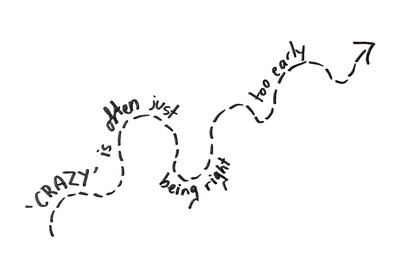
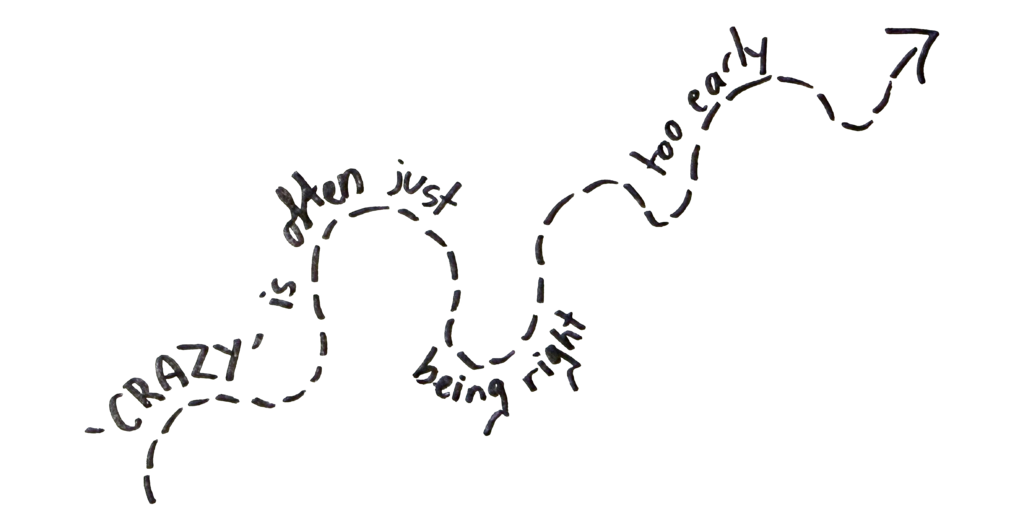
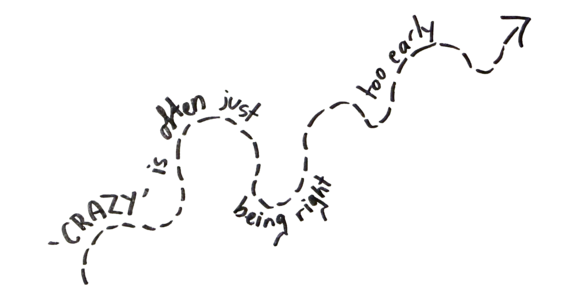
Sketch by Sarah Bassett
If you could do another job in another era, what would it be and when?
I am obsessed with music. It has always been a huge part of my life and it has started to infiltrate my work more and more. If I could have done another job in another era, I would have loved to be a music producer.
The only problem is that it is far too mathematical for me. My dyslexic brain cannot read music, so it would have been a complete disaster. But the idea of being someone like Jamie XX or Nicolas Jaar or Mark Ronson, people who have a real foundation in classical music or music theory and then translate that into something contemporary, feels incredibly appealing.
So I guess it would have been in the 90s or early 2000s, whenever that golden moment of that type of music really was. I think I would have loved that.
Are there books that have guided or influenced you along the way?
All books have helped me in some way. Photobooks, libraries, magazines… As I said earlier, they have always been a kind of therapy for me. So the broad answer is that everything I have read has shaped me.
But there is one book I always come back to and that I often gift to people. It is called Seeing Things by Joel Meyerowitz. It is a children’s guide to looking at photographs, and I love it because it captures something that feels very close to how I see the world.
I have this almost childlike sensibility, where I still get excited about things, I talk to strangers, I email people I am not supposed to email, I have very little fear or formality in that sense. And I never want to lose that.
The book reflects that spirit. It takes these deep, sometimes quite serious Magnum photographs and pairs them with a child’s interpretation of what is going on. It is such a beautiful reminder of looking at the world with curiosity and innocence, seeing things with fresh eyes.
So it is not that the book “influenced” me in the traditional sense, but I think it captures how I hope to move through the world.